

PROTACs (PROteolysis TArgeting Chimeras) – Targeted Protein Degradation
Targeted Protein Degradation (TPD) presents a promising strategy for addressing undruggable proteins, which constitute over 85% of disease targets. TPD harnesses the cell’s intrinsic protein degradation mechanism, known as the ubiquitin-proteasome system (UPS), to eliminate disease-causing proteins. This innovative approach involves the deployment of small molecules capable of binding both to the protein of interest (POI) and to an E3 ubiquitin ligase. By doing so, these molecules induce the degradation of the POI via the proteasome pathway.
PROTACS (PROteolysis TArgeting Chimeras)
PROteolysis TArgeting Chimeras (PROTACs) exemplify a cutting-edge strategy within TPD. PROteolysis TArgeting Chimeras (PROTACs) are small, bivalent molecules engineered to selectively recruit E3 ubiquitin ligases, facilitating the degradation of specific disease-causing proteins within cells. The design of PROTACs typically incorporates three key components: a ligand that binds to the E3 ligase, a ligand that binds to the target protein, and a linker that connects the two.
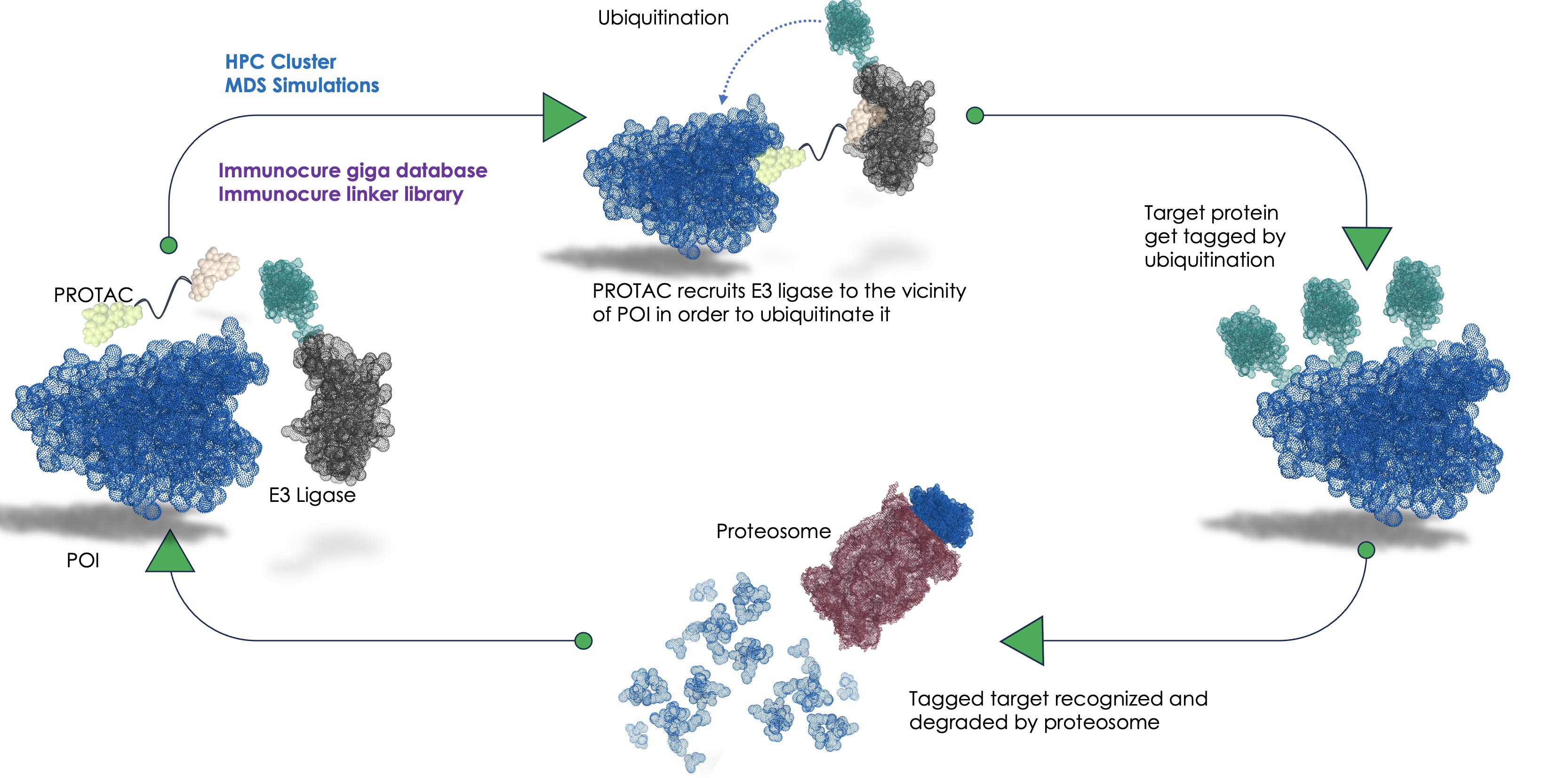
Employing our advanced DrugX engine of AxDrug drug discovery platform, we leverage generative AI tools to construct chemical libraries, exploring the extensive chemical space suitable for virtual screening. Through our computational expertise in rational drug design, we harness computer-aided drug design (CADD) tools to assess and optimize predicted ligands, enhancing their binding affinity and selectivity towards E3 ligases such as cereblon (CRBN), von Hippel-Lindau (VHL), inhibitors of apoptosis (IAP), mouse double molecule 2 (MDM2), and the target protein of interest (POI).
In the development of PROTACs, the length, composition, and flexibility of the linker play pivotal roles in facilitating efficient binding and degradation. Our approach focuses on optimizing the linker to ensure appropriate spatial orientation and proximity between the target protein and the E3 ligase. This optimization process is guided by machine learning models and validated through Molecular Dynamics simulations and Free Energy Perturbation studies.
Our modular toolkit offers flexibility, allowing for the derivation of various types of PROTACs tailored to different E3 ligases. This includes CRBN-based PROTACs, VHL-based PROTACs, IAP-based PROTACs (also known as SNIPERs), MDM2-based PROTACs, Kelch-like ECH-associated protein 1 (KEAP1)-based PROTACs, and Homo-PROTACs.
The molecules generated through this meticulously crafted protocol are then subjected to rigorous scrutiny using our in-house ADME (Absorption, Distribution, Metabolism, and Excretion) and toxicity models. This comprehensive evaluation process enables us to finalize the most promising PROTAC candidates for further development and potential therapeutic applications.